Thirty years after the death of fashion designer Ossie Clark, Sarah Rodrigues explores his impressive legacy.
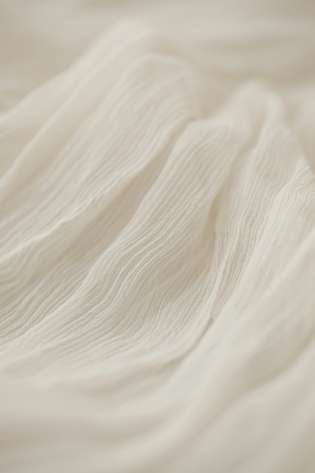
Thirty years after his tragic and untimely death - and more than half a century after his heyday - the name Ossie Clark remains synonymous with a particular kind of sensuality: plunging necklines, tiny waists, billowing sleeves and diaphanous fabrics that seemed to move as seductively as the women wearing them. His dresses belonged unmistakably to their era - yet their appeal has proved remarkably timeless.
"Clark saw a more romantic side to life and was ahead of the fashion curve," says Dr Sian Weston, Senior Lecturer in MA Textile Design at Chelsea College of Arts. While much of the Sixties was defined by the sharp, graphic lines of Mod fashion, she says, Clark offered something altogether more "wistful".
“His fashion presentations were notable too,” says Sonnet Stanfill, Senior Curator of Fashion at the V&A, where Clark-designed garments are on display. “Breaking free of the calm, measured affairs of traditional fashion shows, Ossie Clark ensured that his presentations were theatrical events. They were held at venues like Chelsea Town Hall and Dingwalls dance hall in Camden. In attendance were rock stars, artists, the rich and the fashionable. Accompanied by music, celebrities and top models danced down the catwalk.”
Ossie’s own beginnings were considerably less glamorous. Born Raymond Clark in Liverpool in 1942, he came from a working-class family and was making clothes by the age of ten, encouraged by his mother and an art teacher who recognised his talent. His aptitude for drawing eventually led him to Manchester's Regional College of Art, where he met a group of young creatives including David Hockney and the woman who would become both his wife and his most important collaborator: Celia Birtwell.
After winning a scholarship to the Royal College of Art in London, Clark graduated with the only first-class degree awarded that year and, within three months, his graduation collection had appeared in Vogue.
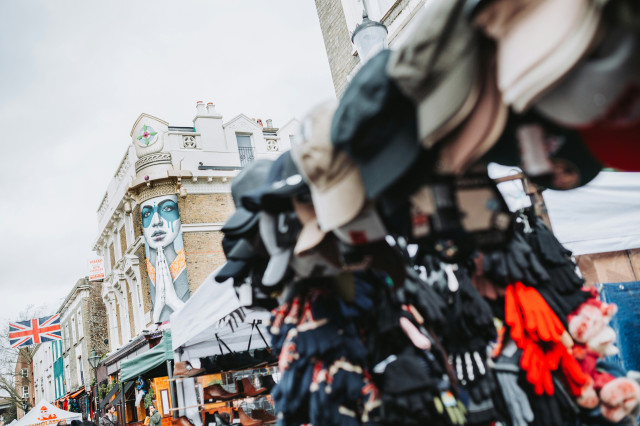
While his rise was meteoric, it was his mastery of cut that set him apart. Clark drew inspiration from the Thirties, embracing long lines, fluid draping and bias-cut fabrics to create clothes that followed rather than constrained the body. Indeed, he’d often source vintage garments from Portobello Market, which he’d then take apart, in order to understand the intricacies of their construction.
Ossie Clark sought inspiration from Portobello Market in West London
His "precision and understanding of how textiles behave on the female form" was exceptional, says Stanfill. “Not as well-known is a range of superbly fitted classical coats, suits, and jackets he executed in Harris tweed, suede, and crepe.”
It was this rare ability, rather than simply the decadent legend surrounding his life, that made Clark's clothes so desirable. Dr Weston is cautious about the oft-repeated suggestion that he somehow possessed an instinctive awareness of the female form, instead pointing to his mastery of cutting and draping. The result was clothing that allowed fashionable women to dance and move easily while still standing out.
A socialite of the time, Candida Lycett Green, once said, “In a Bill Gibb, I feel like an Odeon cinema, but in Ossie Clark, the reaction from men was just unbelievable.”
And then there was Celia.
If Clark was the master of the cut, Birtwell was the visionary behind many of the prints that transformed his clothes into something both ethereal and forever memorable. The pair had met as students in Manchester before reconnecting in London, and their creative partnership began in earnest with a 1966 collection for Quorum, the influential Kings Road boutique owned by Alice Pollock.
"This was a partnership made in design heaven," says Dr Weston. Birtwell's prints were engineered around Clark's designs, creating clothes that were simultaneously playful, romantic and technically sophisticated. Stanfill agrees, saying that “Ossie Clark’s flattering silhouettes combined with Celia Birtwell’s dreamy textiles produced some of the most remarkable garments of the period.”
Birtwell's textiles were often inspired by the natural world, with colourful, swirling patterns that began as sketches before being translated into hand-printed fabrics using silk screens. Each season, she produced a series of designs for Clark to choose from - and together, they created a look that was part wood nymph, part Hollywood goddess.
Many of Birtwell's prints were inspired by the natural world
Their clothes also perfectly captured the moment. At Quorum, Clark became one of the defining designers of Swinging London. Jane Birkin, Jean Shrimpton and Marianne Faithfull wore his designs, while Mick Jagger commissioned clothes from him and Bianca Jagger became a client. These famous faces helped establish Clark as one of the era's first truly celebrity-backed designers – what Dr Weston describes as an early form of "celebrity endorsement".
By embracing the bleak romance of a ‘live fast, die young’ mentality, it would be easy to leave Ossie Clark there: in a haze of chiffon, cigarettes and celebrity, forever preserved as the King of the King's Road. Yet both Stanfill and Dr Weston argue that this mythology can obscure what made him genuinely important.
"What gets lost in the tales of celebrity and excess," says Stanfill, "is Clark's fundamental understanding of how to make clothes women want. The designer himself once said, ‘Fashion isn't just clothes. It's what's happening at the moment in everything.’”
Dr Weston suggests that his story should also be understood as that of a working-class man who scaled heights within a fashion system that had previously seemed unattainable.
Indeed, his career was not without difficulties. The attributes that made his clothes exceptional – his insistence on quality materials and intricate construction – were not always compatible with commercial success. A later partnership with Radley Fashions, however, saw him attempt something that now seems markedly ahead of its time: a more affordable Ossie Clark line that retained the essential elements of his designs. Stanfill describes it as a precursor to the diffusion lines, which have now become commonplace.
Clark's later life was increasingly overshadowed by addiction, financial problems and personal tragedy. In 1996, he was brutally murdered in his West London council flat by a former lover, at the age of 54. But focusing on this tawdry ending risks reducing a remarkable designer to another casualty of success - and excess.
A more interesting - and, indeed, respectful - lens is the question of why, decades later, his influence remains so visible.
Dr Weston points to the continued prevalence of deep-V maxi dresses, balloon sleeves and gauzy fabrics, while identifying brands including Rixo and La DoubleJ as contemporary inheritors of Clark's maximalist spirit. Stanfill, meanwhile, notes the influence of his long lines and fluid draping on successive generations of designers, with figures from Manolo Blahnik to Anna Sui paying homage to his work.
Perhaps that’s the real secret of Ossie Clark's enduring appeal. Fashion evolves, silhouettes change, and every generation dreams up its own version of bohemia - even while drawing heavily on past incarnations of the look. But Clark seemed to understand something more elemental: how clothing can make the body feel freer, more beautiful and more alive.
His dresses conjure a London of rock stars, late-night parties and beautiful people dancing at the most fashionable addresses on the King's Road. The resale prices, on the rare occasions that originals become available, are testament to that. The true magic of an Ossie Clark, however, lies in the cut, the movement - and in the way his clothes made the women wearing them feel.
Ina Yulo Stuve sits down with entrepreneur and author Hermione Olivia to discuss her foray into the wellness industry, the importance of building a community, and the launch of her debut novel.
High-end watches aren't merely timekeepers. The top 10 expensive watches mentioned below are all laced with a rich heritage, craftsmanship, and exceptional attention to detail.
In this edition of Women Who Launch, Ginny reveals how she engages with their top customers and shares what it takes to lead one of the country’s fastest-growing fashion brands.