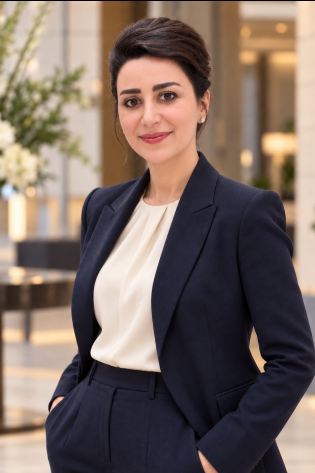

She is also the first woman to become President of the Section of Aesthetic Medicine and Surgery at the Royal Society of Medicine, an institution that had not created a new section for 35 years. She holds academic positions at UCL, King's College London and Shanghai Jiao Tong University, has published more than 60 peer-reviewed papers and authored two Springer textbooks.
Yet none of that is what strikes me most when we talk. It is her insistence that aesthetics should begin with a conversation, not a syringe. "I assumed a career in medicine would be built on technique," she tells me. "Technique matters, but the difference between a good outcome and a poor one is usually a conversation that happened before anyone picked up a needle."
It is a philosophy that feels increasingly relevant in an industry that can sometimes make ageing feel like a problem to be fixed rather than a biological process to be understood. For Souphi, the face is not a collection of wrinkles, lines and areas requiring correction. It is a living piece of tissue, affected by sleep, stress, hormones, nutrition, inflammation, lifestyle and, perhaps most importantly, how we feel.
"I was trained to treat causes and symptoms, not appearance," she explains. "Skin that looks tired is usually telling you about sleep, inflammation, stress, emotional state, hormones or sun exposure, and none of those are solved with a syringe." Her approach is what she calls biology-led aesthetic medicine.
Put simply, she wants to know what the tissue is doing before deciding what it needs. "Traditional cosmetic medicine starts with a shape and works backwards to a product. I start with the biology, the quality of the skin, inflammation, structural support — and then decide whether an injectable is even the right tool."
Sometimes, she says, the answer is skincare, sleep and a review three months later. That restraint is refreshing. And it is also why I wanted to meet Souphi.
More Than Skin Deep
My own interest in her work began with JULÄINE, a regenerative injectable that takes a very different approach to conventional fillers. Rather than simply adding volume, JULÄINE uses poly-L-lactic acid microspheres and LASYNPRO™ technology to stimulate the skin's own collagen production. The manufacturer's information describes it as a gradual treatment designed to improve firmness and smoothness rather than create an obvious transformation.
Souphi is one of the clinicians championing this broader move towards regenerative aesthetics. "It is a message rather than a material," she explains when I ask her to describe the science in simple terms. "You are not filling a space. You are asking the skin to rebuild its own scaffolding, then getting out of the way while it does." That idea appealed to me immediately.
I had JULÄINE treatment myself, and, as Souphi had warned me, this wasn't something where I walked out of the clinic looking dramatically different. The whole point is that the process is gradual, plus there is a little bit of downtime as your face recovers from the treatment.
But after my second treatment, a month after the first, I started noticing a difference. My face seemed fuller in a way that didn't look filled, while my skin looked smoother, brighter and healthier. It wasn't the sort of change that made people ask whether I'd had "work done". In fact, it was quite the opposite. I simply looked better. And perhaps that is the most interesting development in aesthetic medicine: the best result increasingly seems to be the one nobody can identify. "Luxury used to mean visible spend," Souphi says. "Now it means nobody can tell." Her patients, she tells me, want to be told they look well, not that they look "done".
"That is technically harder, not easier. Restraint takes more assessment and more sessions, and it requires you to turn work down when it is not needed."
The Collagen Conversation
The science of ageing has changed significantly since Souphi first entered the profession. "Ten years ago I planned a treatment. Now I plan a year." That shift is fundamental. Instead of seeing an individual wrinkle and treating it in isolation, she looks at the condition of the tissue as a whole. "Skin quality first, structure second, refinement last," she says.
It is an approach that makes sense when you consider what actually happens as we age. Collagen production declines, the skin changes, recovery slows and the underlying architecture of the face evolves. Add in environmental exposure, stress, hormonal changes and lifestyle and it becomes clear that ageing isn't simply something that happens at the surface. This is why Souphi is particularly interested in regenerative aesthetics. "We are moving away from simply filling wrinkles towards encouraging the body to repair itself," she says. That doesn't mean fillers have suddenly become obsolete. Rather, she believes they are one tool among many, and that the future lies in understanding which tool is appropriate for which tissue, at which stage.
With JULÄINE, patience is part of the process. Souphi says early skin changes can appear within weeks, but meaningful improvement develops over roughly three to six months and can continue after the final session.
"Collagen does not work to our timetable," she says. "The patience is not a side effect of the treatment. It is the reason the result looks natural." The official JULÄINE guidance similarly emphasises gradual collagen regeneration and describes treatment as being administered by trained medical professionals.
Treating The Person, Not The Face
Perhaps the most compelling part of Souphi's philosophy, however, has little to do with injectables. She believes psychology is as important as anatomy. "Anatomy tells you what you can do. Psychology tells you what you should do, and whether you should do anything at all."
It is one of the reasons every consultation begins with questions that might seem surprising in an aesthetic clinic: How are you sleeping? How are you feeling? What is happening in your life? What exactly is it about your appearance that is bothering you? Because, as she points out, the request and the problem can be two entirely different things. "Someone asks for lip filler and what they are describing is exhaustion." That distinction matters.
A technically perfect treatment can still leave somebody unhappy if it doesn't address the reason they came through the door in the first place. Souphi has even made saying "no" part of her clinical philosophy. "Not treating is a clinical decision, not a failure to sell." Some patients, she says, are too young. Some have already had too much treatment. Others are asking for a change that won't solve what is actually troubling them. It is an unusually powerful position in an industry that has historically relied on selling more.
The Ageing Revolution
Ask Souphi what she thinks women in their forties should actually be doing if they want to age well over the next twenty years and her answer is wonderfully unglamorous. "Sleep, nutrition and muscle." Then comes proper assessment of bloods and hormones, followed by attention to tissue quality.
"Prevention is far cheaper than correction, in every sense." Injectables, she says, are the smaller part of the equation. "I would put physiology and daily habits at the majority of the outcome and injectables at the remainder." It is a remarkably sensible message coming from someone whose career is built around aesthetic medicine. And it is central to her latest book, More Than Skin Deep, which explores the relationship between appearance and wellbeing. The book also examines meditation, gratitude and forgiveness through the lens of science and neuroscience.
Her argument is not that meditation will suddenly rebuild your collagen. Rather, sustained stress can affect sleep, inflammation and the body's ability to repair itself, all of which can influence how we look and feel. "None of this replaces medicine. It sits underneath it."
For Souphi, wellbeing isn't a shopping list of supplements, treatments and gadgets. "It is mostly the absence of low-grade urgency," she says. "That feeling of being slightly behind all the time." I rather like that definition.
Beauty Without a Blueprint
Perhaps inevitably, someone who has spent years researching beauty across different ethnicities and cultures has a particularly nuanced view of what beauty actually means. Souphi is a Middle Eastern woman who grew up and trained in the UK and spent many years living and working in East Asia. Her research has explored ethnic beauty and the ways ideals of attractiveness change across cultures.
"When I first qualified I thought in proportion and ratios," she says. "Anatomy still matters, and some things read as attractive almost everywhere, symmetry, good skin, signals of health. Above that layer, almost everything moves."
The nose admired in one country might be corrected in another. Jaw width, eyelid shape, lip fullness and facial projection all change according to geography, culture and generation. "The mistake is exporting one ideal and calling it objective." Instead, she wants to treat people towards "the best version of themselves", taking into account their heritage, family features and what they themselves actually want. It is a philosophy that feels particularly important now, when social media has created a strangely homogenised version of beauty.
Souphi is surprisingly blunt about it. "Social media has quietly replaced expertise with visibility." Having a huge following, she says, doesn't necessarily make someone an expert. "Being known and being good are two separate projects."
Growing Older, Differently
Perhaps the most telling part of our conversation comes when I ask Souphi how her own relationship with ageing has changed. "It has softened." In her twenties, she saw ageing as something that happened to the face. Now she sees it as something that happens to tissue, sleep, recovery and the body's ability to bounce back from a bad week.
"The lines bother me far less than they used to." There is no suggestion that she has rejected aesthetic medicine. Quite the opposite. But she has rejected the idea that looking your age is somehow a failure. "I decided some time ago to look like myself at my age rather than like an argument for treatment." It is perhaps the best explanation of her philosophy.
Natural isn't about doing nothing. It is about doing enough and knowing when enough is enough. Her own definition of beauty is beautifully simple: "A face that looks like it belongs to the person wearing it, and the joy they feel in their heart."
And suddenly the title of her book makes perfect sense. Because perhaps the future of aesthetics isn't really about looking younger at all. It is about looking like yourself, rested, healthy, alive and entirely recognisable, for as long as possible.
And if a little help from science can make that version of you look brighter, smoother and more comfortable in your own skin, perhaps that isn't vanity. Perhaps it is simply another form of wellbeing.
I met Souphi at Mallucci London, the prestigious London clinic founded and run by renowned plastic surgeon Mr Patrick Mallucci, where she practises alongside the team and her philosophy of subtle, considered and biology-led aesthetic medicine comes to life.
For more information, visit www.drsouphi.com