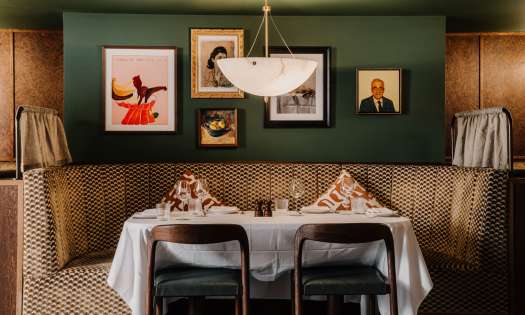
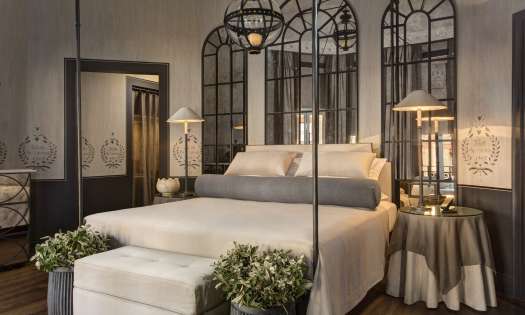
In Budapest, where history hums and beauty lingers, Kristýna Jandová discovers a hotel composed like a symphony. Below, read her review of the Aria Hotel.
Budapest is a city that already feels orchestrated. Its grand boulevards rise and fall like crescendos, thermal waters hum beneath its streets, and history lingers in the air like a familiar melody. From the ornate cafés of the 19th century to the raw beauty of its ruin bars, Budapest is layered, expressive, and deeply emotional. It is a city that does not simply exist, it performs. Tucked into this musical landscape, just steps from St. Stephen’s Basilica, Aria Hotel Budapest does not merely respond to the city. It converses with it. Here, music is not a theme, but a language, a philosophy, and a way of inhabiting space.
A City That Sings
To visit Budapest is to surrender to rhythm. You feel it in the gentle curve of the Danube, in the echo of footsteps across stone bridges, in the ornate façades that seem to carry centuries of stories. This is a city shaped by art, by literature, by café conversations that last hours, by a devotion to beauty that is never rushed.
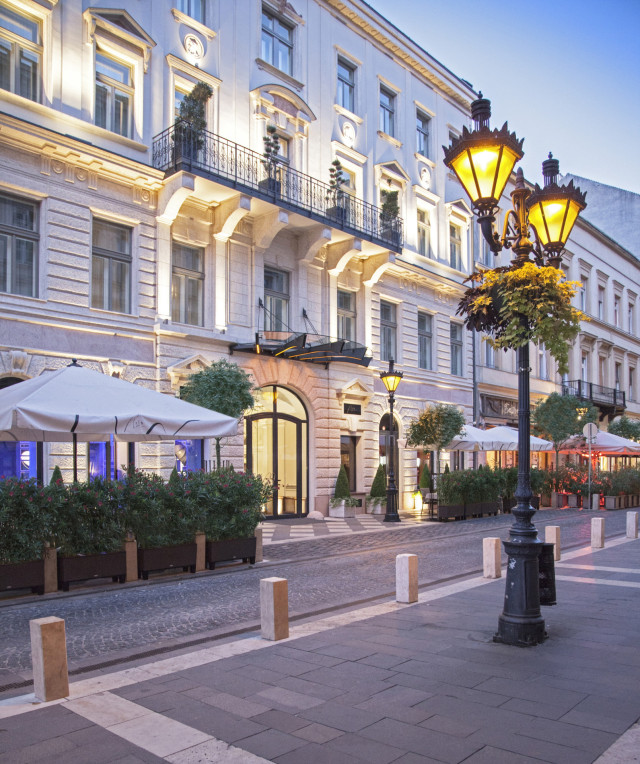
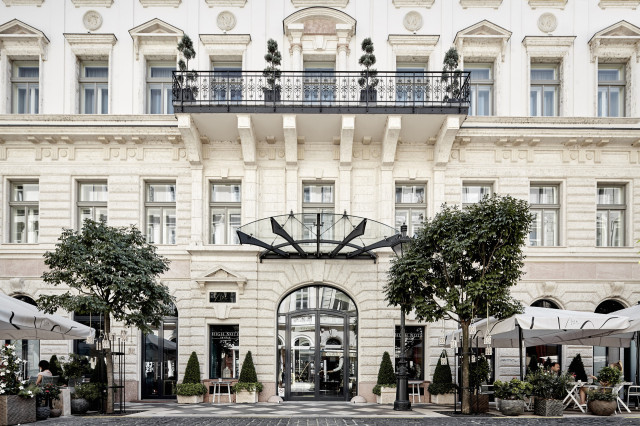
Aria Hotel Budapest feels like a natural extension of this spirit. It is not a hotel that tries to impress. Instead it invites you to slow down, to notice, and to listen. From its discreet entrance on Hercegprímás Street, it unfolds gradually, revealing layers of meaning, mood, and memory.
Where Music Becomes Architecture
At the heart of Aria is a concept that feels both daring and deeply intuitive. The entire hotel is structured around four musical genres: opera, classical, jazz, and contemporary. Each one shapes not only the aesthetic of its wing, but its emotional atmosphere.
For interior designer Zoltán Varró, music was never meant to be a visual metaphor alone. It was the emotional foundation of the entire project. He often begins his designs by listening, selecting a piece of music that reflects the mood he imagines for a space. “Music is very important to me. In many cases when I begin designing a new project, I first find a piece of music that reflects the mood I imagine for it. After that, it becomes much easier for me to visualise what the space should look like.”
With Aria, that process was elevated to its purest expression. It was a rare opportunity for him to translate sound into space, to imagine how different genres might feel if you could physically enter them.
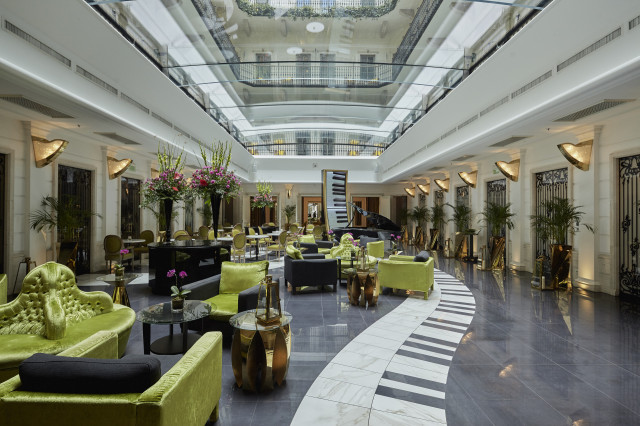
The lobby offers the first hint of this transformation. A piano-key motif flows across the floor, drawing you inward, then upward, toward a towering LED wall where the pattern becomes fluid and dynamic, like a living waveform rising towards the sky. This motif is not decorative. For Varró, it is deeply symbolic. “The flowing form appears on the floor only in its formal shape,” he explains, “but on the LED wall it transforms into a dynamic, undulating motion. This symbolises my ideas and thoughts about music.”
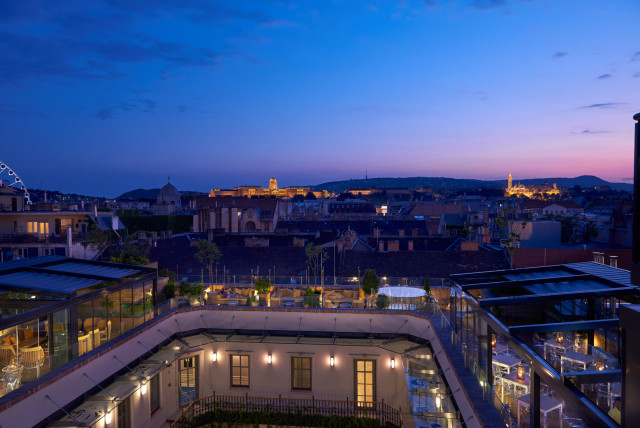
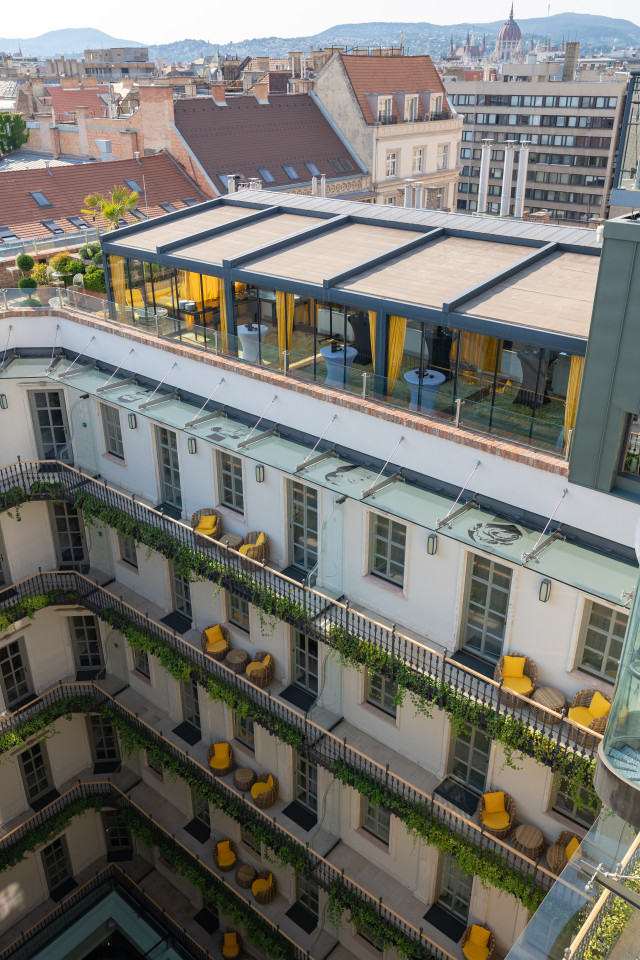
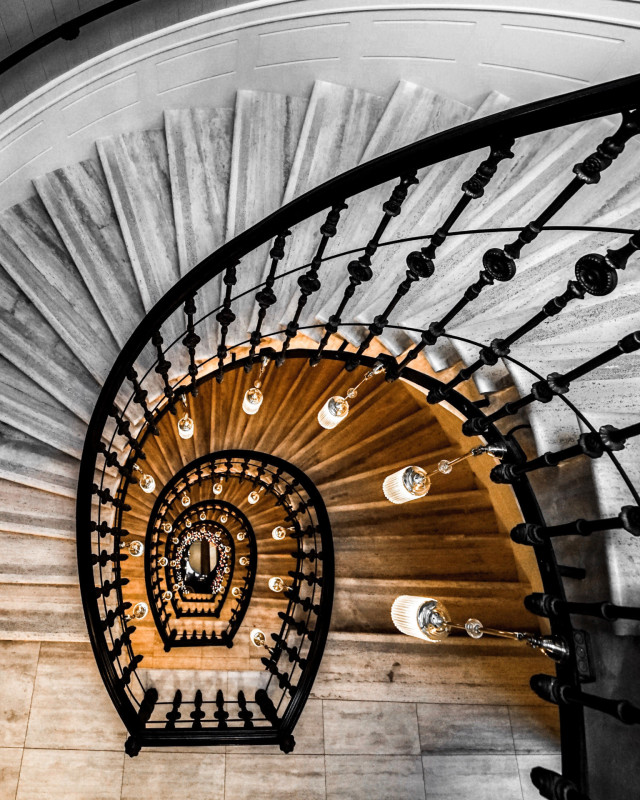
Above, a contemporary glass roof floods the inner courtyard with light, creating a striking dialogue between historic architecture and contemporary design. Varró believes that renovating a historic building should never result in a museum. The past must be honoured, but never frozen. In Aria, old and new do not compete. They coexist, just as classical and modern music do within us.
Four Genres, Four Worlds
Each of Aria’s wings is a world of its own, shaped by atmosphere rather than literal interpretation.
The opera wing is inspired by the elegance and drama of icons such as Maria Callas. It is rich, theatrical, and unapologetically romantic. Deep colours, plush fabrics, and expressive details create a sense of grandeur that feels intimate rather than overwhelming.
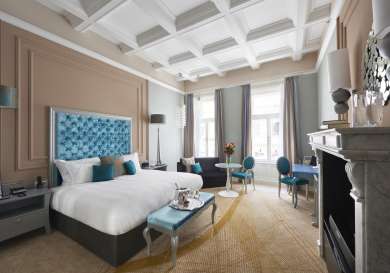
The classical wing draws from the noble interiors of 19th-century Budapest. Soft tones, refined materials, and harmonious proportions recall the city’s aristocratic past. It feels luminous, calm, and quietly majestic.
Jazz, according to Varró, was the most complex genre to translate into architecture. He wanted to capture the mood of New Orleans jazz clubs while grounding it in Budapest’s own architectural language. The solution came in the form of natural brick, a material that appears in both worlds. In the jazz rooms, brick even appears overhead, wrapping the space in warmth and intimacy, like a low-lit club where time dissolves.
The contemporary wing brings in pop art references, bold colours, and playful contrasts, while remaining anchored in classical forms. It is youthful, vibrant, and full of personality.
Rather than feeling themed, these wings feel emotional. You do not choose them based on style alone. You choose them based on mood.
Rooms With a Soundtrack
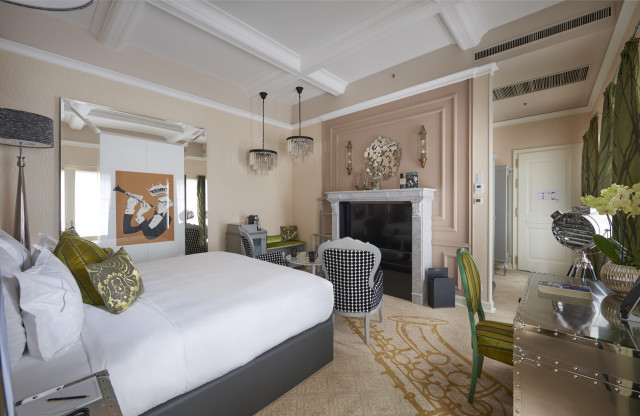
Aria’s 49 rooms and suites are not simply places to sleep. They are carefully composed environments, each one dedicated to a musical legend. Caricature-style portraits by Czech artist Josef Blecha dominate the walls, offering a sense of character and warmth that feels personal rather than performative.
But the experience goes deeper. Each room is paired with books about its artist, and when guests enter, that musician’s music begins to play. It is a subtle gesture, yet deeply evocative, transforming arrival into a moment.
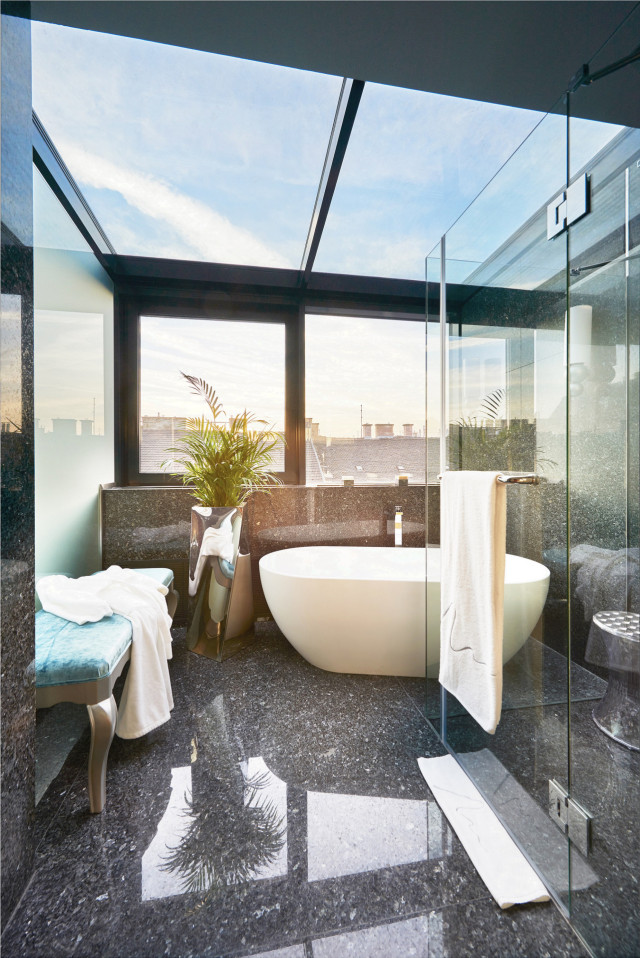
Technology is seamlessly integrated. iPads, curated music libraries, docking stations, and modern entertainment systems exist alongside tactile pleasures such as velvet upholstery, marble bathrooms, and custom lighting. Comfort here is not flashy. It is intuitive.
Some rooms overlook the quiet internal Music Garden courtyard, while others open toward the rooftops of Budapest. No two feel exactly alike. Each has its own rhythm.
A Hotel That Truly Lives Through Music
What makes Aria truly exceptional is that its relationship with music does not end with design.
The hotel has its own music director, Kornél Magyar, a role that transforms Aria from a beautiful concept into a living cultural hub. He curates the hotel’s entire soundscape, organises live performances, and knows the city’s musical calendar intimately. Whether a guest seeks a last-minute opera ticket, a hidden jazz set, or insight into contemporary concerts, he guides them to the best of Budapest’s vibrant scene.
This personal musical stewardship is rare in hospitality, and it deepens the hotel’s connection to the city’s artistic life. It is no surprise that over the years Aria has quietly become a refuge and gathering place for world-renowned musicians and composers passing through Budapest, artists drawn not just by comfort but by a shared language of expression and nuance.
Rituals of Pleasure
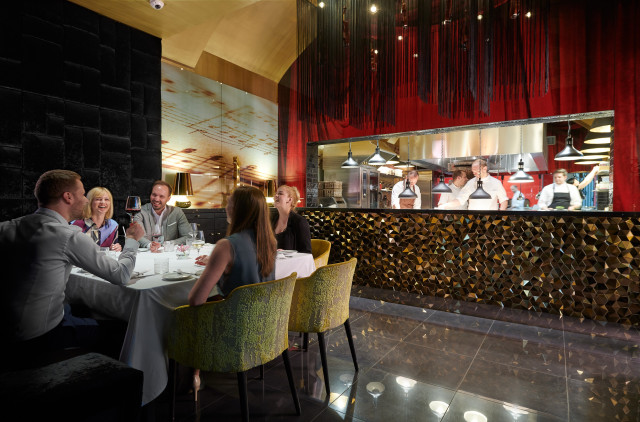
Life at Aria unfolds in rituals. Mornings begin beneath the glass roof of the Music Garden, where breakfast is served in soft natural light, a gentle overture to the day with fresh pastries, house-made granola, and seasonal dishes. Afternoons bring the hotel’s beloved wine and cheese hour, accompanied by live music. Guests gather, conversations form, and time seems to slow. At Café Liszt, the culinary experience continues with seasonal European dishes and touches of traditional Hungarian flavours, from rich goulash to comforting chicken paprikash, served with fresh local ingredients. Dining here is part of the rhythm, as natural and satisfying as a well-composed score.
The Harmony Spa offers a different kind of immersion. A heated indoor pool, jacuzzi, Finnish and infrared saunas, steam room, and fitness area create a sanctuary of stillness. Treatments are inspired by musical harmony, designed to restore balance rather than overwhelm the senses.
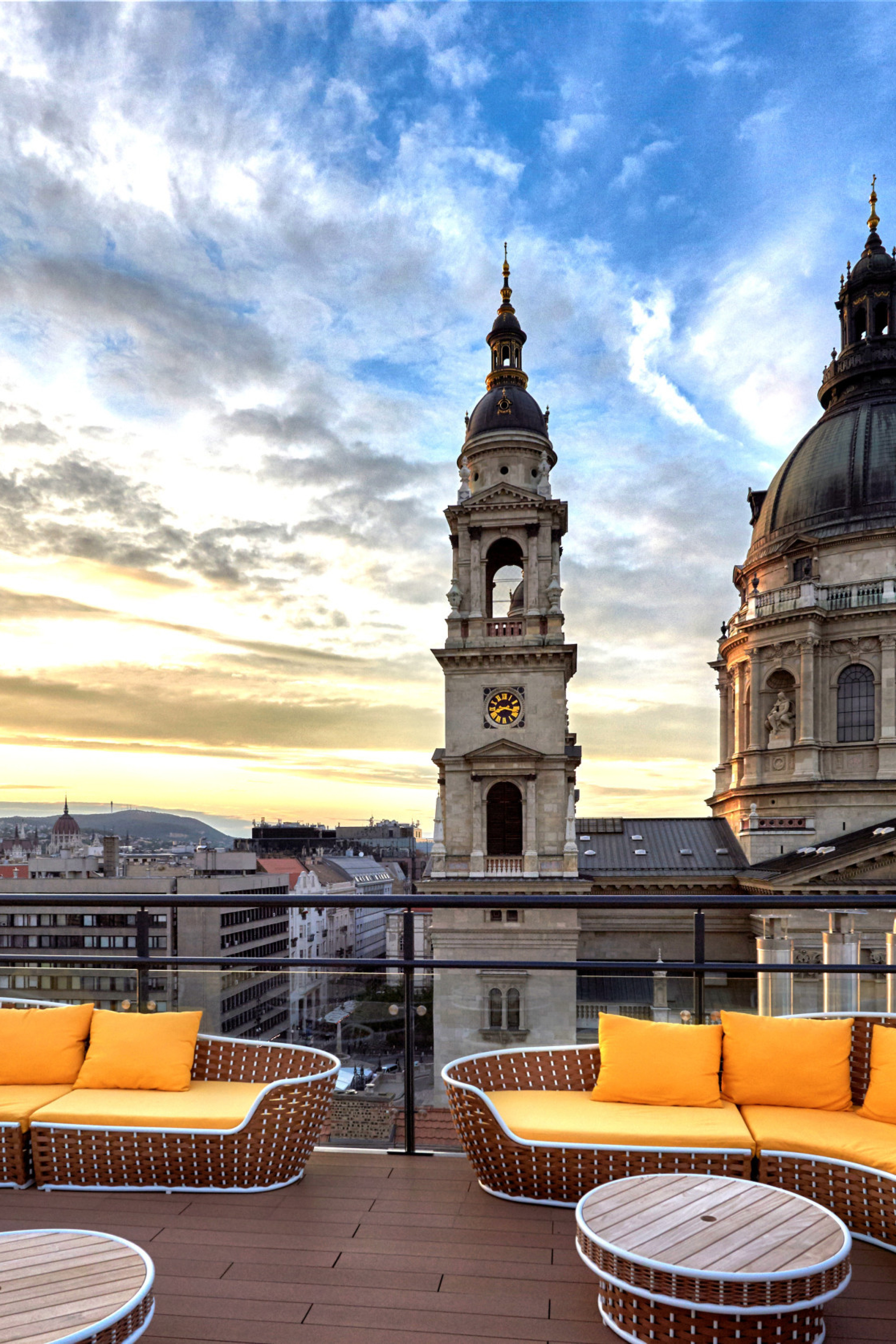
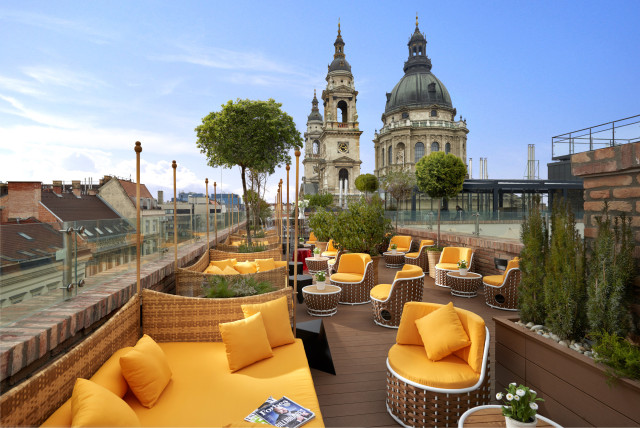
As evening approaches, the hotel lifts upward. The High Note SkyBar, one of the most iconic rooftops in Budapest, opens the city to you in every direction. Basilica dome, glowing rooftops, the shifting colours of dusk. Cocktails arrive like punctuation marks in a sentence you do not want to end. It was the first rooftop bar of its kind in Budapest, and it changed the city’s social rhythm. Now, it remains one of its most poetic.
A New Way of Staying in Budapest
What makes Aria extraordinary is not its awards, though there are many. It is the way it changes how you experience the city.
Budapest’s musical life extends far beyond Aria’s walls. Every spring, the Budapest Spring Festival brings world-class classical, opera, jazz, and contemporary performances to stages across the city, celebrating Hungary’s deep cultural traditions with international stars and Hungarian ensembles alike. In spring and early summer, Jazz Spring at Müpa Budapest offers several days of international jazz, soul, and R&B performances in one of the city’s most resonant cultural venues. And in summer, music pulses everywhere, from open-air stages on Margaret Island to eclectic playlists at concerts, galleries, and bars that populate the city’s vibrant streets. Guests at Aria, guided by Kornél Magyar, can experience this rich musical landscape in a way few travellers ever do.
Staying here does not feel like accommodation. It feels like participation. You return from long walks along the Danube not just to rest, but to re-enter a story. You step back into a place that mirrors the city’s soul, layered, artistic, emotional.
For Varró, success is not measured in recognition alone. It is measured in faces, in the quiet moments when guests discover a detail they did not expect, or pause, or smile without knowing why. He has always seen himself as a kind of magician, someone whose task is to create harmony, to enchant, to make people feel something they can't quite put their finger on.
Aria Hotel Budapest does not try to dazzle. It does not announce itself loudly. It reveals itself slowly, like a melody that becomes more meaningful the longer you listen. Here, architecture becomes emotion. Design becomes narrative. Music becomes space. And once you have listened to Budapest this way, no other stay feels quite as vivid.
For decades, there has been only one answer to the question of where New York's stylish set disappears each summer: the Hamptons. Now, London has its own equivalent.
Desert & Delta Safaris' newest lodge champions regenerative tourism, understated luxury and the joy of experiencing the Okavango Delta at nature's own pace, says Amira Arasteh.